Mexicans “would be eating cat food” if it weren’t for the US and US trade, says US Senator from Louisiana.
This comment came at a great time. Lately, my English classes with Liz have been devoted to junk food vocabulary. Liz just moved from Morelia, Mexico to Arkansas to marry her childhood sweetheart. He legally emigrated from Mexico decades ago, and is now divorced, with an 11 year old daughter. Mealtimes are tense.
Back in Morelia, Liz naturally ate well, without following fads or strictures: lots of fruit and vegetables and home-blended juice, some, but not much, meat and fish, fresh corn tortillas more than white bread, snacks of chili-lime drenched jicama sticks or spicy nuts. Six weeks in, she’s deep in food-system culture shock: cheese-gooey pizza, greasy burgers and fries, squishy white bread, chips, energy drinks, more chips, ice cream, more soda, not a fruit or vegetable in sight. I told her about the “cat food” comment.
“Even coming from Mexico,” she said, “where we have way too much of your food, and kids are getting fat and unhealthy (1), still, at home I can buy fruit everywhere. At least I have the choice. Every market, every day, mango, papaya, strawberries, pineapple, avocados, claro, we’re in Michoacán. Tomatoes, jicama, carrots, squash. Here, I can’t find anything. And what I finally find, it is so expensive. And it’s not habit to eat it. I see kids only with big bags of potato chips and enormous bottles of soda.”
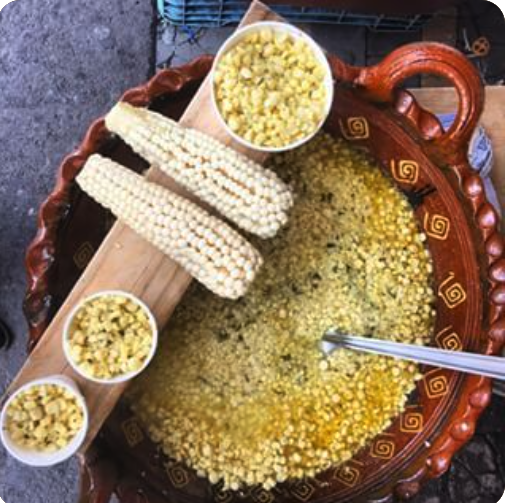
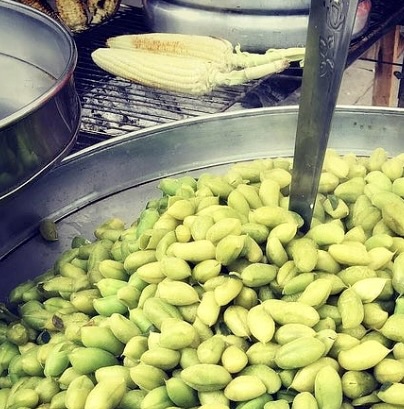
I was reminded of the cerrada San Augustin, a pedestrianized block just below the Morelia Cathedral, lined with snack sellers. On one side, gazpacho stands, colorful heaps of cubed papaya, pineapple, watermelon, mango, ready to fill plastic cups and top with orange juice, lime, chili, cheese, crema — your choice. On the other side, ice cream stands with all the usual plus fabulous flavors like avocado and mamey. A little further down, esquites, roasted corn kernels spiced and sauced 10 different ways, served in a cup, or, at fancier places, in a little clay bowl. A vendor sells elote, roasted corn on the cob (with or without crema, chili, lime, grated cheese). Another offers jicama pops the size of ping pong paddles, ready to coat, or not, in sugar or chili or both. A guy hawks the ever-popular Dorilocos, a bag of Doritos zipped open on the side, for stuffing with, you guessed it, salsa, cheese, lime. Then there are snack bags of garbanzos, beans in skins or not, roasted or steamed. Another corner, sugar- or Hershey chocolate-dipped fried churros.
Yes, plenty of unhealthy stuff, plenty of junk food. But healthier options, too, Snacks based in corn, vegetables, and fruit, still holding on.(2) Snacks you won’t find in the US at the mall or school football game.


This is the painful irony of applying to Mexico the ‘they’d be eating cat food’ metaphor for poverty. The fact is, with US trade, Mexicans are eating worse than ever. Much worse. And getting sicker, accordingly. The American diet that Mexico increasingly imports from the US – both the food itself and the patterns of producing and eating it – is literally killing them with diabetes, heart disease, chronic illnesses, and reduced quality of life.(3)
Nutritional poverty is not the only impoverishment fed by the American diet taking over. As Mexico’s food system entwines with that of the US, cheaper imports from the US drive small producers out of business. Tastes change.(4) Smaller diversified farms get bought up, consolidated, or fall out of production.(5) High value export crops – avocados, berries – replace local or regionally marketed food, which, in turn, couldn’t get prices that would make production viable. Bigger, agribusiness export systems drive illegal clearing of forests, heavier chemical use, contamination of surface water and heavier water extraction. Biodiversity declines, niche and specialized traditional crops suffer.
Food self-sufficiency and resilience at the household, community, regional, and ultimately national levels weaken. Small shops sell more chips, soda, and candy than local fruit and vegetables. Ex-campesinos and their families leave the pueblos for the cities, where jobs– and healthy food – are scarce. People who are able migrate north, legally and otherwise, to pick strawberries, harvest apples, work vineyards, cook, clean, build, and landscape.
“There are parts of Mexico where it is now really difficult to find fruits and vegetables…Instead of the tianguis markets where local fruits and vegetables were historically inexpensive and plentiful, the food needs of Mexicans are increasingly met by chains like Walmart, Coca Cola-owned OXXO, and Circle K.” (6)
Food traditions in Mexico run deep and delectable, a source of pride and globally recognized. In 2010, UNESCO declared traditional Mexican food part of the intangible cultural heritage of humanity, reflecting integration across community-rooted practices of planting, harvesting, cooking, and eating. Corn is at the heart, with at least 60 heirloom varieties, plus beans typical to each region, and more than 150 different chilis across Mexico. Food-farming systems unique to Mexico persist from pre-Hispanic times. Pre-US trade times.
Mexican cuisine has moved its traditions into the fine dining realm, now, as well. Mexican restaurants in Mexico and in the US gather awards and regularly hit “top” lists with star chefs. Star chefs who seek out the heirloom corn, chilis, and greens that agribusiness is driving out. The food that if it weren’t for the power of the US agri-food system might not be so hard to find that it is turned into expensive, specialty signature dishes.
Fortunately, Mexican agriculture and traditions also go north. More than 10 million tons of fruits and vegetables, and over 1 million metric tons of avocados from Mexico save at least some Americans eating only chips, burgers and fries.
NOTES
(1) One in three Mexican schoolchildren overweight or obese – a 27 percent rise in 12 years…Mexico’s biggest killers are now cardiovascular diseases and diabetes. ..only 40 years ago, the main causes of death here were malnutrition and infectious diseases. The speed at which Mexicans have made the change from a diet dominated by maize and beans to one that bursts at the seams with processed fats and sugars poses one of the greatest challenges to public health officials. Mexico is the largest consumer of ultra-processed products, including sugary drinks, in Latin America.
(2) Healthy, fruit- and veg-centric options are readily turned into high-calorie zappers, but still much healthier than ultra-processed, zero-nutritional value junk food.
(3) “The country’s food environment has been transformed as a result of economic growth and free trade agreements. In the past 40 years, the Mexican diet has shifted from mainly fresh and unprocessed foods to ultra-processed products high in sugar, salt, and fat. This transformation, along with aggressive marketing techniques by the food industry, has also led Mexico to become one of the countries with the lowest breastfeeding rates in the world. Today, 23·1% of the Mexican population’s total dietary energy comes from ultra-processed food products. WHO recommends a maximum of 5–10% of total energy per day from free sugars—in Mexico, over two thirds of the population exceed this. The country is also among the highest consumers of sugary beverages globally; they represent approximately 10% of total daily energy intake in adults and children and make up 70% of total added sugar in the diet.”
…attempts to develop prevention policies faced immediate opposition from multinational food companies. Even basic efforts, such as healthy hydration recommendations were never fully implemented due to strong pressure from the beverage industry. Junk food and sugary drinks were banned from schools, albeit the guidelines did not include penalties for non-compliance, which has led to lax implementation.” The Lancet. September 2020. Obesity in Mexico: rapid epidemiological transition and food industry interference in health politics.
(4) It is increasingly difficult to find, or afford, healthier food options, especially in smaller towns and rural areas, as fast, cheap junk food and soda replace fruit and vegetables in supermarkets and shops all over Mexico. “..over the last two decades, the Mexican diet has been transformed. Consumption of beans dropped by half. In the last 14 years, consumption of fruit and vegetables dropped by 30% – largely replaced by processed food and sugar-sweetened beverages…. In part due to the North American Free Trade Agreement, which took effect in 1994, the availability of processed food has soared. Even in the most remote villages, little stores sell packaged biscuits, pastries, doughnuts and cakes, and sodas and non-carbonated sweetened drinks.” The Guardian, 2013.
(5) “NAFTA put almost two million small-scale Mexican farmers out of work, in turn driving illegal migration to the United States….When NAFTA removed trade tariffs, companies exported corn and other grains to Mexico below cost. Rural Mexican farmers could not compete…..At the same time, Mexico reduced its subsidies to farmers from 33.2% of total farm income in 1990 to 13.2% in 2001. Most of those subsidies went to Mexico’s large farms. These changes meant many small Mexican farmers were put out of business by highly subsidized American farmers……In response to NAFTA’s competitive pressure, Mexican agribusiness used more fertilizers and other chemicals, costing $36 billion per year in pollution. Rural farmers expanded into marginal land, resulting in deforestation at a rate of 630,000 hectares per year.” Reference: Council on Foreign Relations, July 2020. NAFTA and the USMCA: Weighing the Impact of North American Trade. Andrew Chatzky, James McBride, and Mohammed Aly Sergie
(6) “Since NAFTA, subsidized corn, soy, and meat products in the U.S. have altered a food landscape that now includes people outside its borders. This has included the cheap, corn-syrup-heavy products that have saturated the North American market with very little regulation, pushing aside more traditional, local foods.” … “There are parts of Mexico where it is now really difficult to find fruits and vegetables…One kilo of fruit costs the same as a 600-milliliter Coca-Cola.” …. “Instead of the tianguis markets where local fruits and vegetables were historically inexpensive and plentiful, the food needs of Mexicans are increasingly met by chains like Walmart, Coca Cola-owned OXXO, and Circle K.” References: How NAFTA Destroyed the Mexican Diet, Behind the trade agreement that changed eating in North America forever. Lisa Martine Jenkins Sep 19, 2018. Eating NAFTA: Trade, Food Policies, and the Destruction of Mexico. Alyshia Galvez, University Press, 2018
 Uprooted